Motorola Razr+ 2026
The Motorola Razr+ 2026 is a high-end foldable smartphone that combines a compact design with cutting-edge technical specifications, featuring a high refresh rate display, a next-generation processor, and a versatile camera system.
Quick facts
Summary
Basic details and key specifications, selected for the product type.
- Brand
- Motorola
- Product type
- Smartphone
- Updated
- Weight
- 189 g
- Dimensions
- 88.09 × 73.99 × 15.32 mm
- Profile height
- 171.42 mm
- Profile width
- 73.99 mm
- RAM
- 12 GB
- RAM type
- LPDDR5X
- Storage
- 256 GB
- Battery capacity
- 4500 mAh
- Front camera resolution
- 32 MP
- Bluetooth version
- 5.4
- NFC
- Yes
- Operating system
- Android 16
Article
Detailed Motorola Razr+ 2026 review
Introduction and launch context
The Motorola Razr+ 2026 is positioned as the brand's flagship offering for the global foldable smartphone market in 2026. This device continues the trajectory of the Razr line, consolidating its presence in a competitive segment where innovation in compact formats and the integration of cutting-edge technology are fundamental pillars.
As part of Motorola's strategy to remain at the forefront of the foldable mobile sector, the Razr+ 2026 aims to provide a user experience that combines the portability characteristic of foldable designs with the capabilities of a high-end terminal. Its launch in the global market reflects the company's intention to compete directly with other leading manufacturers in this specific niche, betting on a proposal that balances design, functionality, and performance.
On the software front, the device runs on Android 16, placing the Razr+ 2026 in the context of the latest iterations of the world's most widely used mobile operating system. This platform choice ensures compatibility with the latest applications and services, as well as access to the security and optimization features that characterize current versions of Android, thereby reinforcing its competitive position against other foldable devices available in the 2026 market.
Design, dimensions, and materials
The Motorola Razr+ 2026 adopts a compact structure designed to maximize portability without compromising the display surface. In its folded state, the device measures 88.09 mm in height, 73.99 mm in width, and 15.32 mm in thickness. This configuration allows the smartphone to fit comfortably in a pocket or small clothing compartments, maintaining the slim profile characteristic of the Razr line.
Regarding ergonomics and weight, the terminal has a total mass of 189 g. This value is distributed uniformly to facilitate one-handed handling, a relevant aspect given the device's foldable format. The construction incorporates a metal frame, a material that provides structural rigidity and a solid tactile feel, contributing to the chassis's durability against daily impacts.
The design efficiency is reflected in the screen-to-body ratio, which reaches 84.9%. This percentage indicates that a significant portion of the front surface is dedicated to visualization, minimizing bezels and optimizing the available space within the device's total dimensions. The combination of a metal frame, contained weight, and high screen proportion defines the physical identity of the Motorola Razr+ 2026 as a foldable device balanced between functionality and design.
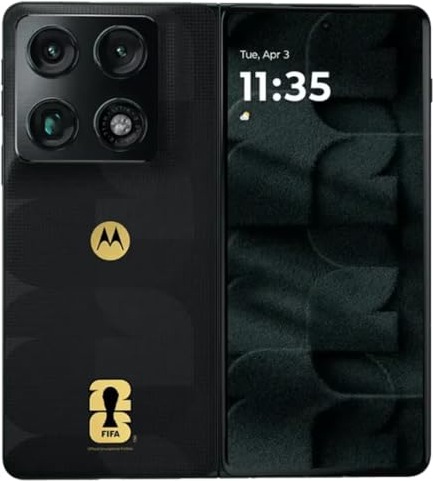
Display and Visual Capabilities
The Motorola Razr+ 2026 features a 6.9-inch main display with a resolution of 1080 × 2640 pixels and an aspect ratio of 22:9. This combination places the pixel density at 414 ppi, a figure that ensures sharp content reproduction in both applications and full-screen video.
The panel operates at a refresh rate of 165 Hz and supports an adaptive refresh rate, allowing the system to dynamically adjust the refresh speed according to the type of content being displayed. This mechanism helps reduce power consumption when the interface is at rest or static material is being viewed, while delivering maximum fluidity in gaming scenarios or fast scrolling.
As for touch response, the sampling sensor operates at 300 Hz, which reduces the latency between finger contact and the system's visual response. This figure is particularly relevant in fast-interaction contexts, such as navigating menus or using games that demand precision in gestures.
Brightness and Image Formats
The panel's typical brightness is 1200 nits, a level sufficient for comfortable reading under direct sunlight. Under high-contrast conditions, the panel reaches an HBM brightness of 3000 nits, which extends the perceived dynamic range in scenes with very bright areas against dark backgrounds.
For high dynamic range content playback, the display supports the Dolby Vision format, which enables per-frame color and brightness encoding, improving chromatic fidelity in films and series that use this standard.
Dimming and Always-On Display
The device implements DC dimming (direct-current pulse-width modulation) to reduce brightness at low levels. Unlike PWM dimming, which modulates intensity through rapid pulses, DC dimming varies the current continuously, minimizing perceived flicker and providing greater visual comfort during nighttime reading or prolonged use in dark environments.
In addition, the display includes an Always On Display function, which keeps the time, notifications, and essential widgets visible without requiring the user to unlock the device, reducing how often the full panel needs to be activated.
| Feature | Value |
|---|---|
| Size | 6.9 in |
| Resolution | 1080 × 2640 px |
| Aspect ratio | 22:9 |
| Pixel density | 414 ppi |
| Refresh rate | 165 Hz (adaptive) |
| Touch sampling | 300 Hz |
| Typical brightness | 1200 nits |
| HBM brightness | 3000 nits |
| HDR format | Dolby Vision |
| Dimming | DC |
| Always On Display | Yes |
Processing Platform and Performance
The Motorola Razr+ 2026 is powered by the Qualcomm Snapdragon 8s Gen 3, a processor built on a 4 nm manufacturing process that places the device in the high-performance segment of the foldable smartphone market. This platform integrates an 8-core CPU with a cluster clock speed of up to 3.0 GHz and an 8 MB L3 cache, a configuration designed to maintain smooth operation in both everyday tasks and more demanding workloads.
CPU Architecture and Neural Processing Unit
The eight-core layout allows the system to switch between high-performance cores and energy-efficient cores depending on demand. The maximum 3.0 GHz frequency in the primary cluster, combined with the 8 MB of L3 cache, reduces access times to frequently used data and contributes to a responsive experience in multitasking applications. Complementing the CPU, the chipset integrates a Hexagon NPU, dedicated to accelerating on-device advanced processing operations, enabling local inference models to run with lower power consumption than if they were delegated to the CPU or GPU.
Graphics Processing Unit
The GPU in the Snapdragon 8s Gen 3 operates at 1100 MHz and features 768 shading units, delivering a compute capacity of 1689.6 GFLOPS. These figures position the graphics component in a range well suited to rendering games at high resolutions and playing back multimedia content with complex visual effects, all within the thermal constraints inherent to a compact foldable form factor.
RAM and Storage
The device is equipped with 12 GB of LPDDR5X RAM organized in a quad-channel configuration, which increases the available bandwidth for both the CPU and GPU and supports fluid multitasking with multiple applications running in the background. As for internal storage, 256 GB is provided using UFS 4.0 technology, which offers significantly higher read and write speeds than previous generations, reducing application load times and the transfer of large files.
Benchmark Scores
Measurements from reference benchmarks provide an objective indication of the platform's overall performance:
| Test | Result |
|---|---|
| AnTuTu (overall score) | 1,846,775 |
| AnTuTu (CPU) | 552,755 |
| GeekBench 6 (single-core) | 1,984 |
| GeekBench 6 (multi-core) | 5,001 |
| GeekBench 6 (GPU) | 9,198 |
The overall AnTuTu score, approaching 1.85 million points, and the multi-core GeekBench result of 5,001 points confirm that the Snapdragon 8s Gen 3 maintains a competitive performance level within the 2026 high-end tier. The single-core figure (1,984) indicates a quick response in tasks that depend on a single thread, such as interface interaction or application launch, while the GPU score of 9,198 supports the system's ability to sustain high frame rates in graphically demanding scenarios.
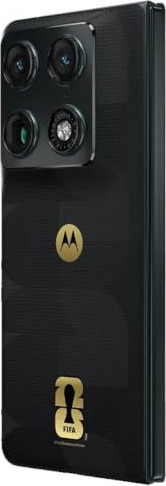
Camera System and Photography
The Motorola Razr+ 2026 features a rear camera system centered around a 50 MP main sensor. This unit includes Optical Image Stabilization (OIS) to enhance sharpness in low-light conditions or during movement, and offers 2x optical zoom. The main sensor has a field of view of 122°, a specification also listed for the ultra-wide mode, suggesting broad angular coverage for capturing extensive scenes. The system includes an LED flash for illumination in low-light environments.
Software features available for the rear camera include HDR mode, Panorama capture, and Portrait mode, which allows isolating the subject from the background. Regarding video recording, the device supports a maximum resolution of 2160p (4K) and offers the ability to record in slow motion at a resolution of 1080p.
The front camera is designed for selfies and video calls, with a resolution of 32 MP. The maximum image resolution it can capture is 6528 x 4896 pixels. Unlike the rear camera, the front sensor does not feature autofocus or a ToF (Time of Flight) sensor for depth measurement.
Battery, endurance, and charging systems
The Motorola Razr+ 2026 features a non-removable lithium polymer battery with a capacity of 4500 mAh. This design choice ensures a compact integration within the foldable device's chassis.
In terms of endurance, the manufacturer estimates a battery life of approximately 15.41 days, a figure that reflects the energy efficiency of the platform under standard usage conditions.
Charging systems
The device supports fast wired charging with a maximum power output of 45 W. With this capability, the estimated time to charge from 0% to 50% is 20 minutes, while a full charge requires approximately 50 minutes.
In addition to wired charging, the Razr+ 2026 includes support for wireless charging and reverse wireless charging, allowing users to transfer energy to other compatible devices. However, the system does not include bypass charging, a feature that would allow the device to be powered directly without routing power through the battery.
It is important to note that a charger is not included in the product box. Users will need to have a compatible adapter to take advantage of the specified maximum charging speeds.

Connectivity, Networks, and Interfaces
The Motorola Razr+ 2026 incorporates a suite of wireless connectivity standards oriented toward the latest generation of networks. In the realm of data communication, the device supports Wi-Fi 7, allowing it to leverage the improvements in latency and bandwidth offered by this standard. It also includes support for Bluetooth 5.4, with specific compatibility for Bluetooth Low Energy (BLE), facilitating efficient connections with low-power peripherals.
Regarding mobile networks, the terminal offers 5G and LTE connectivity. Among the verified 5G frequency bands is n77. For navigation and geolocation, the device features support for GPS. Short-range connectivity includes NFC, which is useful for mobile payments and quick device pairing.
Physical input and output interfaces center on the USB Type-C port, which operates under the USB 2.0 standard. This connector enables device charging, operation in USB storage mode, and the connection of peripherals via USB OTG. The Motorola Razr+ 2026 does not include a 3.5 mm headphone jack, an infrared port, or an FM radio. However, it does allow the creation of a Wi-Fi hotspot to share the internet connection with other devices.
Biometric Security and Sensors
The Motorola Razr+ 2026 features a dual biometric security system that combines fingerprint recognition with facial recognition. The fingerprint scanner is optical and integrated under the display, allowing for quick and discreet unlocking. Additionally, the device offers an advanced processing-assisted face unlock method that uses the front camera to verify the user's identity.
Regarding internal instrumentation, the phone integrates a wide variety of sensors designed to enhance interaction with the environment and improve navigation accuracy. These include an accelerometer, gyroscope, and compass, which work together to orient the user interface and facilitate geolocation. The ambient light sensor automatically adjusts the screen brightness, while the proximity sensor manages the screen's shutdown during calls. Furthermore, the device includes a barometer for measuring atmospheric pressure and a Hall sensor, typically used to detect the opening or closing of cases or magnetic covers.
Operating system and software
The Motorola Razr+ 2026 ships with Android 16 as its base operating system. This version of Google's mobile operating system serves as the fundamental platform for running the device's applications and services, ensuring compatibility with the latest technical and security specifications of the Android ecosystem.
The user interface and software features are designed to integrate natively with this system version, providing a coherent user experience optimized for the device's architecture. By running on Android 16, the device leverages the resource management capabilities and customization tools inherent to this operating system iteration, without relying on additional software layers not specified in the verified data.
Neutral Technical Assessment
The Motorola Razr+ 2026 is positioned as a device that integrates high-performance components within a compact foldable format, balancing raw power with manageable ergonomics. Its design, featuring dimensions of 88.09 × 73.99 × 15.32 mm and a weight of 189 g, maintains the portability characteristic of the Razr line without compromising the inclusion of advanced hardware.
At the core of the system lies the Qualcomm Snapdragon 8s Gen 3 chipset, a processing platform designed to handle intensive workloads. This central unit is complemented by a 6.9-inch main display offering a refresh rate of 165 Hz, ensuring high visual fluidity for both navigation and multimedia content playback.
The device's battery life is supported by a 4500 mAh battery, a capacity aimed at sustaining the energy consumption of high-performance components during daily use. In the photographic department, the camera system incorporates a 50 MP main sensor, indicating an orientation toward capturing images with a high level of detail and resolution.
The combination of these elements—a latest-generation processor, a high-refresh-rate display, a battery with standard capacity for the segment, and a high-resolution camera—defines the Motorola Razr+ 2026 as a technical proposal that prioritizes feature density in a reduced-size foldable chassis.
Evidence-backed content
Sources consulted for Motorola Razr+ 2026
Documents supporting the information published in this article.
- Security Updates | Motorola Support US en-us.support.motorola.com/app/software-security-update/g_id/7112/produc...
- Flip smartphone with external display l 50MP advanced processing camera | motorola US | motorola razr+ | motorola www.motorola.com/us/en/p/phones/razr/razr-plus-2026/pmipmjq44ms
- Motorola Razr, Razr+, and Razr Ultra (2026) User Guide manuals.plus/m/a29f9b68f76dc4923f63e2abd6dbb285297bacec008ffd99163923c3f...
- Motorola Razr 2026 Rumors: Release Date, Price, Specs www.cnet.com/tech/mobile/motorola-razr-2026-rumor-roundup/
- New Motorola razr+ 2026 Features & Specs | AT&T www.att.com/buy/phones/motorola-razrplus-2026.html
- I went hands-on with the Motorola Razr 2026 series and I have some very mixed feelings, but there's one model that definitely stands out www.androidcentral.com/phones/motorola/motorola-razr-2026-series-hands-o...
- Should you wait for the Motorola Razr 2026? Well, it's complicated... | Android Central www.androidcentral.com/phones/motorola/motorola-razr-2026-should-you-wai...
- The Razr Plus 2026 is the same but better (and more expensive), but that's not actually a problem. Here's why | Android Central www.androidcentral.com/phones/motorola/motorola-razr-plus-2026-review
- I tried Motorola's Razr Plus 2026: it falls right into the middle child trap - PhoneArena www.phonearena.com/reviews/motorola-razr-plus-2026-review_id7947
- Motorola Razr Plus 2026 Review: Best Yet, But Not for Everyone << Smartphones :: Gadget Hacks smartphones.gadgethacks.com/news/motorola-razr-plus-2026-review-best-yet...
- Motorola Razr+ (2026) Review: Better Battery Life Can't Hide Familiar Hardware | PCMag www.pcmag.com/reviews/motorola-razr-plus-2026
- Motorola Razr Plus 2026: Ultimate Buyer's Guide www.androidheadlines.com/motorola-razr-plus-2026
- Motorola Razr Plus (2026): specs, benchmarks, and user reviews nanoreview.net/en/phone/motorola-razr-plus-2026
- Motorola Razr 2026 Official: Three | MegaMobileContent www.megamobilecontent.com/news/2026/04/29/motorola-razr-2026-official-la...
- The repetitive specs and excessive US prices of Motorola's Razr (2026) and Razr+ (2026) are here - PhoneArena www.phonearena.com/news/motorola-razr-2026-razr-plus-2026-specs-features...
Structured data
Motorola Razr+ 2026 technical specifications
Specifications are kept separate from the editorial narrative, making them easy to consult without interrupting the reading experience.
Variants
Variants of Motorola Razr+ 2026
A single page covers every commercial version. The table shows only specifications that differ between them.
256 GB - PANTONE Mountain View
- Model
- razr+ 2026
- EAN / GTIN
00840493616919
No visible technical differences have been detected between the variants.